
MY APPROACH
Support without pressure to adapt
Your perspective is the starting point for our work together. Together, we explore how your individual needs, personal resources and the demands of everyday life interact—and where relief or change may be possible. I combine psychological expertise with a nuanced perspective on your personal experiences. Our therapeutic approach is guided by the realities of your life and your own pace.
MY PERSPECTIVE
Your own rhythm deserves space
The drawing reminds me how important it is to trust your own perceptions.
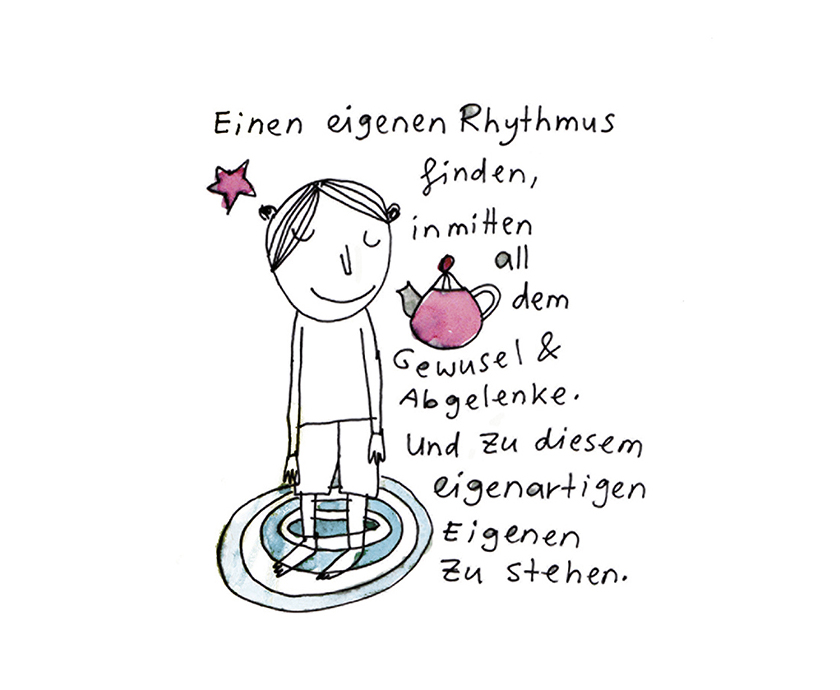
This image has been with me for a long time. To me, it shows how difficult it can be to find your own rhythm amid bustle, distractions and external expectations — and to stand by it. This thought mattered on my own path too. I have often wondered how easily our own perceptions and needs can move into the background.
That is why this drawing has a special place here. It reminds me how important it is to get to know yourself better and trust your own perceptions. Your path does not have to be straightforward. Sometimes it begins with looking more closely: What is on my mind? What do I need? And what truly reflects my own experience?
This attitude also informs my work: I want to support people in taking their own perceptions seriously and developing ways of engaging with everyday demands that reflect their needs. Your own rhythm does not have to be fully found before it is allowed to have space.
MY APPROACH
Therapeutic approaches
My work is guided by a relational, resource-oriented and development-focused approach. Reliability, structure and a safe framework are the foundation of every collaboration. I select approaches in light of the concerns and needs at hand and the circumstances of everyday life.
Person-centred orientation
Therapeutic collaboration is guided by your individual concerns, personal resources and life circumstances. Goals and approaches are agreed transparently, reviewed on an ongoing basis and adapted to your needs. At the centre are your self-determination, your individual pace of development and a trusting therapeutic relationship.
Psychoeducation and understanding autism
Scientific knowledge about autism is considered in relation to your lived reality and personal experiences. This includes, among other things, features of sensory and cognitive information processing, executive functioning and emotional regulation. A nuanced consideration of individual patterns of perception, stress and behaviour provides the basis for deeper self-understanding and for developing strategies relevant to everyday life.
Structure and visual
support
Structured approaches, including elements of the TEACCH approach, are used according to your needs to make daily routines, demands and transitions easier to understand. Visual supports, clearly structured steps and adjustments to the environment can promote predictability, independence and confidence in how to act. The choice of methods takes account of individual processing styles, existing resources and situational demands.
Social Stories and Comic Strip Conversations
Social Stories and Comic Strip Conversations provide a structured, visually supported way to explore social experiences and communication processes. Different perspectives, implicit expectations and possible misunderstandings are presented in an accessible way and reflected on together. The aim is to develop a nuanced understanding of interpersonal situations and expand individual ways of interpreting and responding, without treating particular social behaviours as a universal norm.
Social skills and communication
Social interactions are considered in light of different communication styles, reciprocal expectations and situational contexts. The therapeutic work includes reflecting on interpersonal dynamics and developing individual strategies for communication, managing conflict and setting boundaries. The focus is on expanding your options for social interaction, communicative self-determination and authentic participation, rather than adapting to prescribed social norms.
Stress and emotion regulation
The therapeutic work considers the interplay of sensory processing, physiological arousal and emotional regulation. Individual patterns of stress, early bodily warning signs and existing coping resources are explored in a nuanced way. Building on this, strategies for stress and emotion regulation are developed to meet your needs and, where appropriate, complemented by mindfulness-based, stabilising and body-oriented approaches such as grounding, breath regulation or progressive muscle relaxation.
Perception, needs and self-advocacy
The focus is on fostering interoceptive awareness — the perception of internal bodily signals — and differentiating emotional, bodily and sensory needs. Individual patterns of perception and response are explored in the context of personal experiences and environmental conditions. On this basis, strategies for self-care, consciously setting boundaries and communicating your needs in a self-determined way are developed to strengthen self-efficacy and self-advocacy in everyday life.
Relationships, boundaries and
sexuality
Interpersonal relationships, closeness and distance, intimacy and sexuality are considered in light of individual relationship experiences, needs and personal boundaries. The therapeutic work supports a nuanced exploration of relationship patterns, communication, consent and sexual self-determination. The focus is on personal experience, reflecting on your own wishes and uncertainties, and developing ways to shape relationships on your own terms.
HOW WE WORK
What shapes our work together
Our work together combines a reliable therapeutic framework with an individual approach shaped around your concerns and the realities of your life.
01
Developing goals together
Your concerns, previous experiences and personal resources provide the starting point for our work together. From there, we set goals together and identify therapeutic priorities that are meaningful to you and realistic in the context of your life.
02
A reliable framework
A clear therapeutic framework, transparent agreements and an approach that is clearly explained provide clarity and a sense of reliability. At the same time, there is room for change: as our work progresses, we review priorities, pace and methods together and adapt them when needed.
03
Communication tailored to you
We adapt communication to your individual ways of expressing yourself and processing information. Alongside conversation, we can use written contributions, chat, visual aids or rating scales. This supports mutual understanding and gives you different ways to participate.
04
Everyday life and personal circumstances
Therapeutic work is connected to concrete everyday situations and your personal circumstances. We take into account your resources, individual stressors and external factors. Together, we develop and review strategies that are feasible in your day-to-day life.